Online classes

The same practice, from wherever you are.

Live over Zoom. Cameras on. Aravindh sees you and corrects you by name. Not a recording — a live session where he responds to what he sees. Students join from eight countries. Personal attention, even in a group setting.

Most online yoga is a recording you follow. This is a room you enter. Aravindh sees your shoulders, notices when your breath shortens, and adjusts the practice for the people in front of him — even through a screen. Students from Australia to the Gulf say the same thing: it feels like he is in the room.
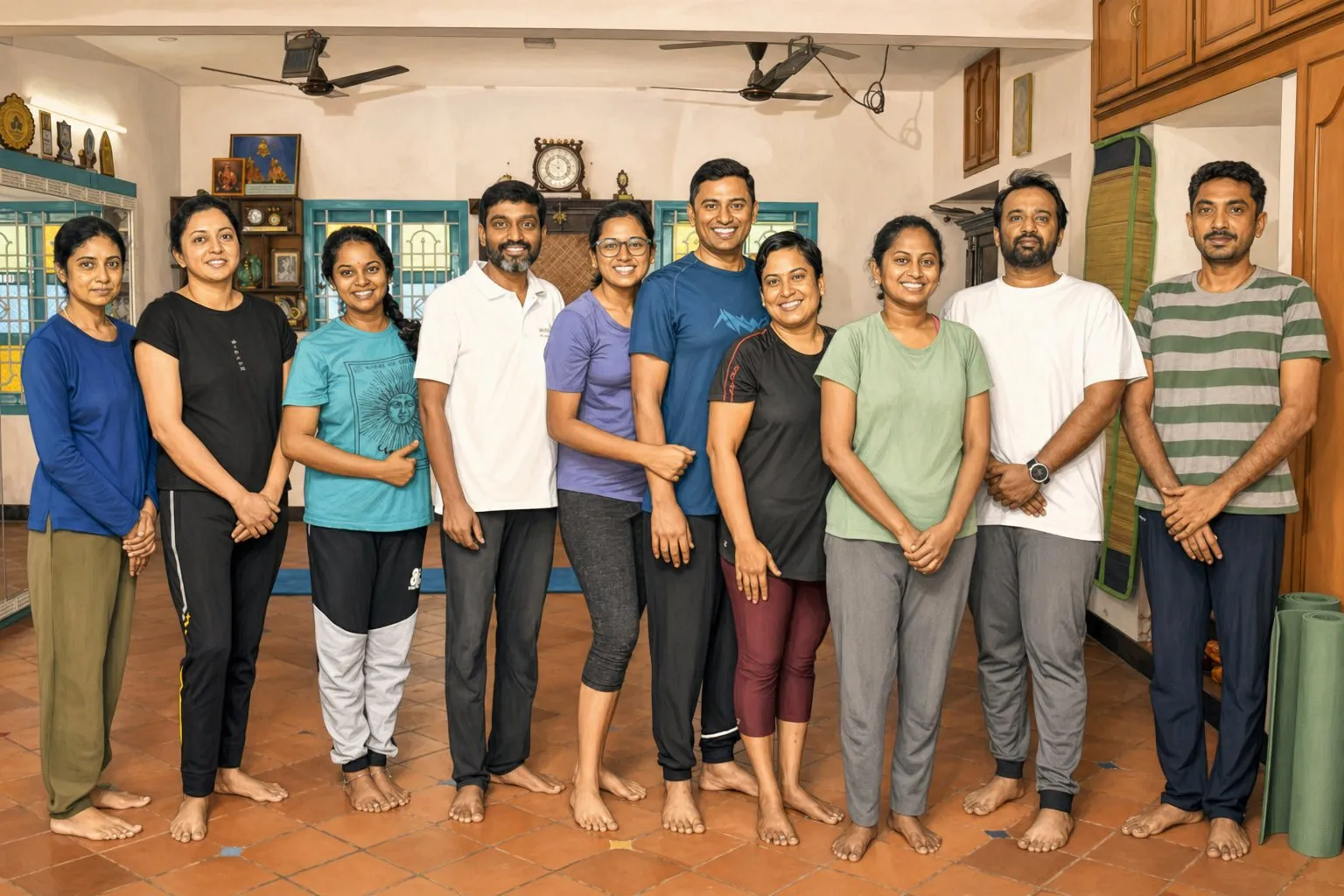
The Aram Yoga online and in-person sangha — group photo

Each one shaped around a different rhythm of life

Mon–Fri · 6 AM IST

Online group practice

The everyday morning practice. Twenty classes a month. Begin each weekday with breath, asana, and a settled mind — before the day starts asking things of you.

  • Five live sessions per week, 60 minutes each
  • Open to all levels — beginner to long-time practitioner
  • Includes mountain hikes around Salem when the sangha gathers
Tue & Thu · 10:30 AM IST

Women’s exclusive

A women-only space, twice weekly. Eight classes a month. The practice itself is the same; the room is different — calmer, less performative, more candid.

  • Focus on hormonal balance, sleep, and energy through the cycle
  • Pranayama and meditation tuned to the rhythms of women’s well-being
  • A sisterhood that often outlasts the trial
Schedule on enrollment

For students (age 10+)

For school and college students facing board exams, entrance tests, or the steady pressure of constant assessment. The practice builds focus and nervous-system steadiness — not caffeine-driven cramming, but the ability to sustain attention without burning out.

  • Pre-exam calm — breath tools that work in the exam hall, not just on the mat
  • Study stamina — sustained attention without the crash
  • A positive peer group — not about marks or comparison

Sessions are scheduled around academic calendars. Parents are welcome to observe the first session.

Not in India? The 6 AM IST slot is late evening in the Americas, mid-morning in Europe, and morning in East Asia and Australia. Aravindh has guided students through time zones, cultural transitions, and the particular weight of living far from home. The practice travels with you.

Viniyoga, guided through Reiki-based awareness

Every posture is adapted to the body Aravindh sees on the screen, not to an idealised image in a textbook. Aravindh watches, names students by name, and corrects in real time.

Underneath the asana sits a quieter layer of attention — Reiki-based awareness — that lets the teacher read the room even at a distance. It's why students from Australia, the US, the Gulf and across Europe report that the online sessions feel meaningfully different from a recorded video class.

The benefits show up off the mat

01

Steadier emotional baseline

Reactions slow. Sleep deepens. Daily stress doesn’t vanish — but it stops setting the agenda.

02

Better self-observation

The recurring patterns you’ve always sensed but never quite seen become visible — and workable.

03

Body that feels lived in

Flexibility, strength, sleep, digestion — the expected benefits, but they arrive almost as side effects.

Frequently asked

Online classes — common questions

How is online practice different from a YouTube video?

Live and two-way. Cameras on. Aravindh sees you and corrects you by name — not a recording, a live session where he responds to what he sees.

A recorded class can't see that your shoulders are climbing toward your ears. He can — and he will say something.

That is the difference between a live class and a recording.

What time zones does this work for?

The 6 AM IST slot lands at evening or late night for the Americas, mid-morning for Europe and Africa, late morning for the Gulf, and lunchtime for Australia / South-East Asia. Most students join from time zones where 6 AM IST is between 8 PM and 11 AM.

Do I need any equipment?

A yoga mat, a steady internet connection, and a camera-capable device. That’s it. No props are required; we’ll suggest household substitutes if a posture calls for one.

What about the days I can’t make the live class?

We provide a personalised home-practice plan and will check in with you. Recorded versions of group classes are not posted publicly — the practice is built around being present in the live room.

What if I need to miss a session?

Just message Aravindh on WhatsApp. There is no penalty for missing a class. Students who travel frequently find the online format works precisely because there is no fixed attendance obligation — you join when you can and the practice continues.


In person — currently Salem

In-person classes.
Small group. Same teacher, every session.

Small groups. Same teacher every session. Real-time corrections in the room. For people who work better with a consistent physical space and structure.

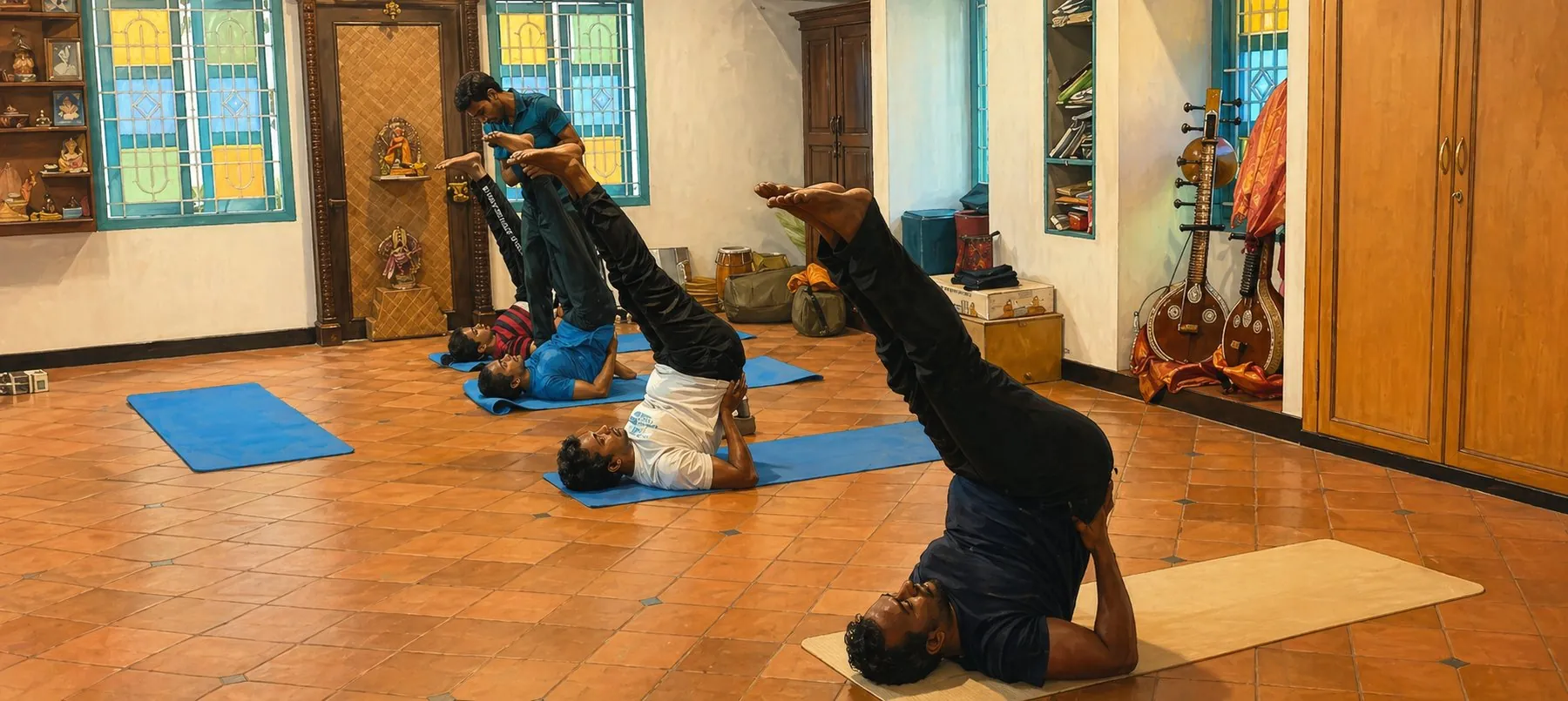
Group in shoulder-stand variations at the Aram Yoga studio in Salem
Two studio formats

Pick the rhythm that fits your week

Tue & Thu — mornings

Direct group classes

Two sessions back-to-back, 6–7 AM and 7–8 AM. Eight classes a month. The workhorse of the studio — most students settle here.

  • Asana adapted on the spot to each body
  • Pranayama woven through each class
  • Personalised home-practice guidance for non-class days
Saturday only — weekend

Weekend exclusive

A single 90-minute Saturday session, 6–7:30 AM. Four classes a month. Built for working professionals whose weekdays are non-negotiable.

  • Longer single session — deeper into pranayama and meditation
  • Same Viniyoga method, slower pacing
  • Home-practice plan covers Mon–Fri

Viniyoga, guided through Reiki-based awareness

Viniyoga is the lineage of T. Krishnamacharya — the principle that the practice adapts to the practitioner, not the other way around. No two students are given the same posture in the same shape. Each class is built around the people in the room that morning.

Underneath the asana, Aravindh works with Reiki-based awareness — a quieter attention to where energy is held or withheld in the body. It's not a separate session. It informs how he reads the room, where he chooses to stand, and which student he chooses to gently re-align next.

Three things students consistently report

01

Heightened awareness, steadier emotions

Mind quiets. Reactions slow down by a beat or two — enough to choose differently in difficult conversations.

02

Patterns become visible

The body is honest. As the asana settles, recurring physical and mental patterns show themselves — and become workable.

03

Better flexibility, strength, sleep

The expected benefits arrive too — but they tend to feel like a side-effect of the deeper work, not its goal.

Practising alongside others changes the practice

The studio holds a small community — doctors, engineers, students, retirees, parents. Shared mornings, shared questions, occasional walks in the hills around Salem. The collective pull is what keeps people coming back on the days they wouldn't have made it on their own.

Studio classes — common questions

How many classes per week?

Direct format: two classes per week, eight per month — Tue and Thu, 6–7 AM and 7–8 AM. Weekend format: one class per week, four per month — Saturday 6–7:30 AM.

Do I need to be flexible to start?

No. Every posture is modified to suit each body. Strength and flexibility build naturally over weeks of consistent practice — we don't optimise for either.

What about the days in between?

You'll receive a personalised home-practice plan after the first week. It's short — usually 15–25 minutes — and built to be repeatable on busy days.

Is this style suitable for someone with injuries?

In most cases, yes. We'll discuss the injury at the trial intake and adapt the practice. For acute or post-surgical situations, the one-to-one track is usually a better starting point.

Begin with the trial

Four to six weeks at the studio — long enough to know whether this is your practice.

Start the free trial →